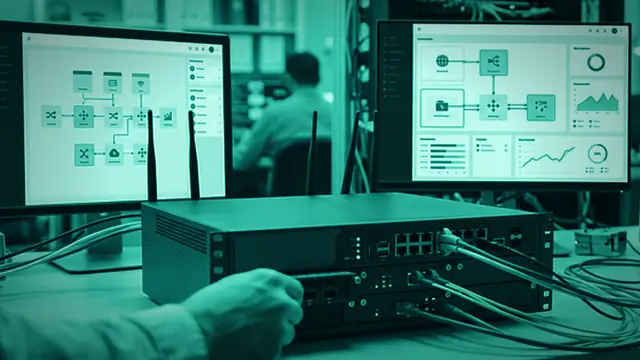


The main difficulty faced by ISPs regarding products returned from the field is ensuring that the CPE preserves its original factory characteristics at the lowest possible cost and time. For large providers, the only viable solution is the adoption of an automated system capable of ensuring this quality at reduced marginal costs.
One of the main virtues of a provider is putting the customer first. Therefore, traditionally, when faced with a complaint, operations take the path of least effort and immediately replace the CPE as a definitive solution. However, this practice brings a critical point:
The hidden cost of “No Fault Found”: Global studies indicate that up to 50% of support tickets originate in the customer's wireless environment (interference, positioning, congested channel), and not from hardware defects in the CPE. The result is an inflated inventory of equipment removed from the field with no physical defects, discarded or awaiting analysis purely due to a lack of reliable diagnostic capability. Source.
As user expectations rise, delivering QoE becomes non-negotiable, and ISPs cannot take risks. It is no longer enough to simply verify if the Wi-Fi radio turns on: it is essential to ensure that throughput reaches the contracted speed, Ethernet ports negotiate at maximum rate under load, IPv4 and IPv6 stacks operate fully, and integration with remote management functions seamlessly.
Faced with these diagnostic difficulties and the technical rigor required, the adoption of specialized and automated CPE validation systems solidifies itself as the primary method to curb the continuous waste of CAPEX and OPEX.
Manual Testing vs. Specialized Automation
Replicating a manual qualification or triage routine in an internal laboratory usually becomes an operational bottleneck. A qualified technician, to minimally cover a CPE, needs to execute:
- Physical inspection and button activation (Reset, WPS);
- Optical power reading and RX sensitivity (GPON);
- Link validation, jitter, latency, and packet loss on each LAN port;
- Bidirectional throughput and stress testing of Ethernet interfaces;
- Dual-stack check (IPv4 and IPv6);
- Registration and VoIP call testing (FXS);
- Throughput measurement and stability in 2.4 GHz and 5 GHz;
- Firmware verification, updating if outdated, and checking remote management parameters (TR-069 / TR-369 / CWMP);
- Quick port analysis and check for known vulnerabilities;
- Manual recording of serial numbers, MAC addresses, and results in spreadsheets.
By adopting an automated solution, these criteria are 100% met.
Comparing a manual vs. automated solution:
| Criterion | Manual Bench Triage | Specialized Automated Validation |
|---|---|---|
| Time per Unit | 20 to 30 minutes | 2 to 3 minutes |
| Repeatability | Low (subject to human fatigue and bias) | 100% deterministic and identical |
| Test Coverage | Partial (focus only on the reported symptom) | Complete across the entire CPE |
| Traceability | Manual notes, scattered spreadsheets | Logs, automatic reports, and photographic records |
| Firmware and Provisioning | Requires separate manual steps | Update and standardization in the workflow |
| Operational Cost | High consumption of qualified technical hours | Simplified operation requiring lower qualification |
Financial Impacts: OPEX, CAPEX, Technical Field Visits, and Churn
The use of automated validations reflects directly on the operator's financial metrics:
- Reduction of unnecessary field visits: Reports from international regulatory bodies, such as the ACCC in Australia, and global operators indicate that inefficient costs associated with support calls and technical visits consume tens of millions annually. The problem worsens when a CPE retrieved from the field is reconditioned after superficial or misdiagnosed triage and ends up being reinstalled at another customer's premises. This equipment, with a hidden flaw, triggers a vicious cycle of new failures, forcing repeated technical visits where the provider accumulates expenses for fuel, qualified labor, and logistical wear, all generated by a validation failure that should have been caught in the laboratory.
- Reduced churn and fewer Call Center complaints: Installing a reused and improperly tested CPE at a new customer's premises generates support calls in the first 30 days of the contract, right in a critical period when subscriber dissatisfaction is most sensitive and can result in early cancellation.
- Efficient inventory turnover: Equipment collected from deactivated customers that functions perfectly no longer sits idle awaiting evaluation. It goes through the test line, is cleaned, receives the approved firmware, and immediately returns to ready inventory, saving the unnecessary purchase of new batches.
Architecture of a Professional Testing Solution for ISPs
A test bench truly aligned with the provider's routine does not need to be an inaccessible machine like those on industrial assembly lines, but rather an intelligent and customized platform that combines control hardware and orchestration software:
- Repeatability and Environmental Control: A test environment with controlled physical interfaces, including calibrated optical attenuation, shielding or fixed distance for RF tests, and simultaneous load on LAN ports.
- Firmware and Management Orchestration: The ability to read the current CPE firmware over the network, apply the stable image approved by the ISP if necessary, and check communication integrity through industry-standard management protocols.
- Real Traffic Stress Testing: Generation of synthetic bidirectional traffic to check whether ports support line rate without losses, avoiding CPEs with intermittent soldering issues or CPU processing saturation.
- Traceability with Visual Evidence: Integration of barcode readers and cameras to capture photographs of the casing and the label containing the serial number/MAC address, linking this data to the pass/fail report generated in the operation's database.
- Cross-Referencing Defect Data: A testing system helps after-sales operations and autonomous agents correlate reported problems with failures identified in field-returned products.
The quality of a network is not measured only by the traffic capacity of its core or the stability of its optical fiber. The final link in contact with the user, the CPE, defines the perceived value of the entire service. Transforming field returns and batch qualification into an automated, traceable, and fast process is the frontier that separates operations struggling with tight margins from those driven by technical and financial efficiency.
Want to improve your ISP's operational efficiency? Contact a Venko specialist by clicking here and get support throughout every stage of your project.
Source: Venko Networks.